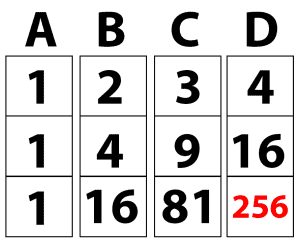
Answer: 256
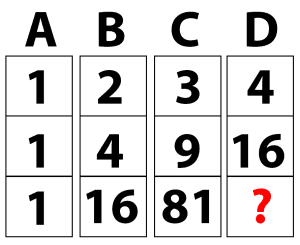
In all columns, from top to bottom, the three numbers in the cells are consecutive squares, starting with the top one.
For example, in A, the top cell is 1, the one below is the square of 1, which is 1. The one below that is the square of the 1 above, which is also 1. Similarly, in B, the top cell is 2, the one below is the square of 2, which is 4, the one below that is the square of 4, which is 16. In C, the top number is 3, the number below is the square of 3, which is 9, and the last number is the square of 9, which is 81. So, in D, the top number is 4, the one below is the square of 4, which is 16, and so the last number is the square of 16, which is 256.